The intelligence barrier platform for battlefield security
Deploy intelligence.
Not infrastructure.
A self-deployable distributed sensing platform that creates an autonomous security perimeter in minutes.
Edge intel + Mission intel
- Deploys in minutes
- Real-time threat classification
- OTA AI upgrades
01 — The problem
Fixed systems protect fixed places.
Defence perimeters, indoor sites and critical facilities are guarded by robust, complex, permanent systems. When a force deploys, none of it comes along — and surveillance falls back to the people on watch.
Cannot deploy: Access controlCCTVSentries What remains: Human observers
02 — GOSSIP
An autonomous perimeter, in minutes.
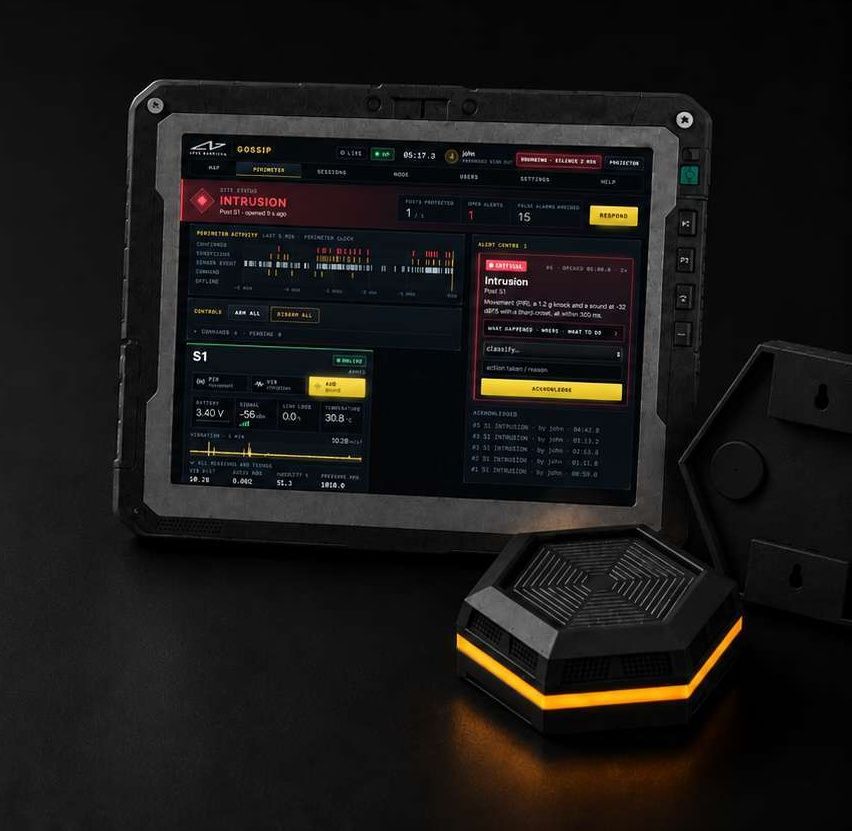
GOSSIP is a self-deployable distributed sensing platform. Place the nodes and they find each other, form a perimeter and watch it — sensing, deciding and reporting with no infrastructure and no connectivity.
Several independent sensors must agree before an alert is raised.
-
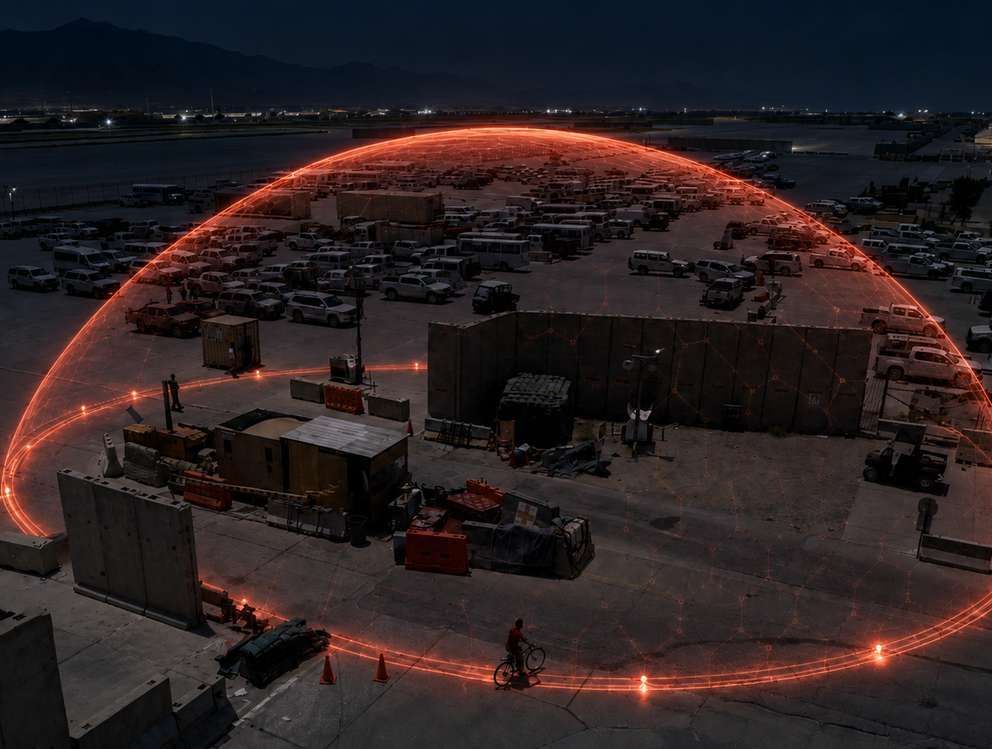
One node
Works alone.
A single unit is an independent sensing device.
-
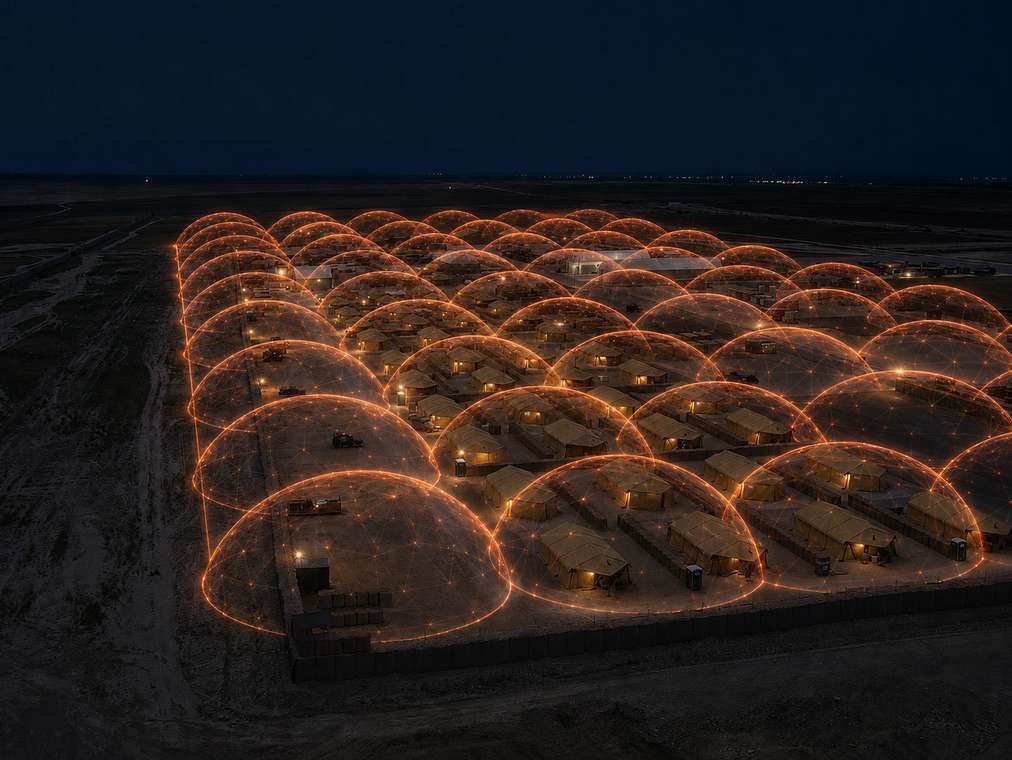
Many nodes
Form a mesh.
Units on the same area link into an intelligent, scalable perimeter.
Edge AI identifies and reports threats in real time — people, vehicles, drones, sabotage — while eliminating false alarms and operating in communications-constrained environments.
Hardware captures signals. GOSSIP creates intelligence.
-
Layer 1 — Edge intelligence
Each node processes sensor data locally, and detects, classifies and scores threats in real time, without relying on continuous connectivity.
-
Layer 2 — Mission intelligence
The platform fuses intelligence from every deployed node into one operational picture, correlates events and identifies higher-level threats: coordinated intrusions, multi-vector attacks and emerging risks.
AI models evolve · New intelligence, same hardware
03 — How it works
From a case of nodes to a watched perimeter.
- 01
Place
Nodes go down where they are needed. No cabling, no site survey.
- 02
Link
They find each other and form a mesh. No router, no network to join.
- 03
Agree
A detection counts only when independent sensors confirm it.
- 04
Report
The operator gets one decision, with the evidence behind it.
04 — Capabilities
What a deployment gets.
- 01
Deploys in minutes
Nodes go down where they are needed. No cabling, no site survey.
- 02
AI-powered edge sensing
Each node processes its own sensor data, without relying on continuous connectivity.
- 03
Real-time threat classification
People, vehicles, drones and sabotage, identified and scored as they happen, with false alarms eliminated.
- 04
Mesh networking
Nodes link to each other. One works alone; many work as one perimeter.
- 05
OTA AI upgrades
AI models evolve and gain new capabilities over the air. New intelligence, same hardware.
- 06
Dual use
Defence and critical infrastructure, on the same platform.
05 — No infrastructure
No WiFi.
No 4G.
No cloud.
Every decision is made on the perimeter. Nothing leaves it, and nothing has to reach it.
- Data leaving the perimeter 0 B
- External dependencies 0
- Uplink required None
06 — Why us
Hardware can be copied. Operational intelligence cannot.
-
6 years
of real-world security operations
-
4,000+ sites
protected across Spain
-
Critical infrastructure
safety and security systems delivered for an energy operator
Six years of security operations at bambai.es built a proprietary record of real threats, false alarms and environmental behaviour. It is what GOSSIP is designed to learn from — and what a hardware clone cannot copy.